

What if we’ve been asking the wrong question?
For over a century, medicine has been driven by a single question: What makes people sick? This question has led to remarkable advances—vaccines, antibiotics, surgical techniques that would seem like miracles to our ancestors. But it’s also left us with a blind spot.
What if we also asked: What makes people healthy?
This isn’t just wordplay. It’s a fundamental shift in perspective—one that opens up entirely new possibilities for how we approach wellbeing. This shift has a name: salutogenesis.
The Birth of a New Question
The term “salutogenesis” comes from the Latin salus (health) and the Greek genesis (origin). It literally means “the origins of health.” The concept was developed by medical sociologist Aaron Antonovsky in the 1970s, and it emerged from a striking observation.
Antonovsky was studying women who had survived Nazi concentration camps. As expected, many survivors showed lasting psychological trauma. But what caught his attention was something else entirely: a significant number of these women were thriving. Despite enduring unimaginable horror, they had somehow maintained their mental and physical health.
This puzzled him. How was this possible?
Rather than asking what broke down in those who struggled (the traditional medical approach), Antonovsky asked what enabled some people to stay well despite overwhelming adversity. This question led him to develop the salutogenic model—a framework for understanding what moves people toward health and flourishing.
The River of Life
Antonovsky used a powerful metaphor to illustrate the difference between the traditional approach and salutogenesis. Imagine life as a river.
The traditional medical model positions doctors as lifeguards standing downstream, ready to pull drowning people from the water. They intervene when things go wrong—treating illness, managing disease, responding to crises. This is essential work, but it’s reactive.
The salutogenic approach asks different questions: What determines how well people can swim? What makes the water calmer in some stretches? Can we teach people to navigate the currents? Can we improve conditions upstream?
The river metaphor acknowledges something important: we’re all in the water. No one stands safely on the shore. Life inevitably brings challenges, stressors, and hardships. The question isn’t whether we’ll face difficulty—it’s whether we have what we need to keep swimming.
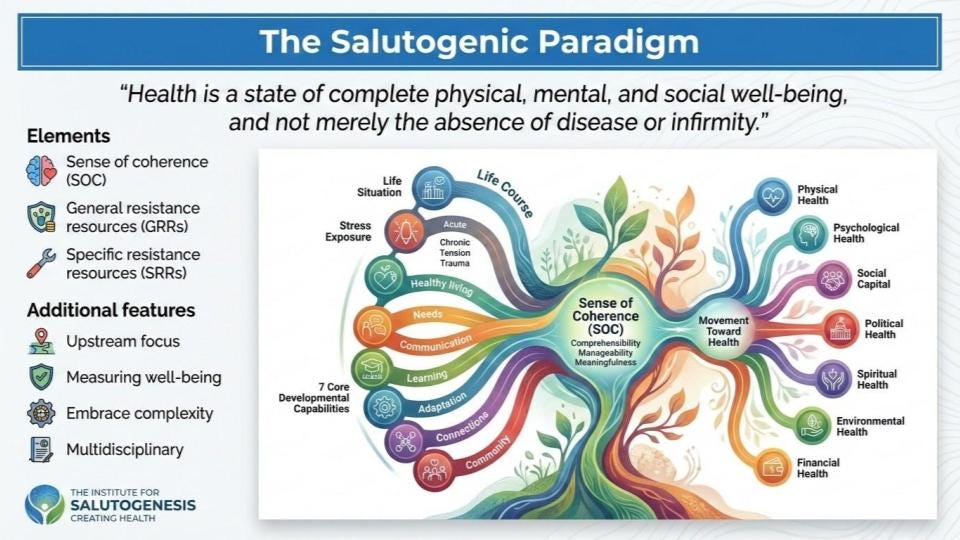
The Sense of Coherence
At the heart of salutogenesis is a concept Antonovsky called the Sense of Coherence (SOC). This isn’t a personality trait you either have or don’t have. It’s more like an orientation toward life—a deep, enduring confidence that:
1. Life is comprehensible. The world makes sense. Even when difficult things happen, they aren’t random chaos. You can understand, at least to some degree, what’s happening and why. This doesn’t mean everything is predictable—just that events can be placed within some coherent framework.
2. Life is manageable. You have (or can access) the resources needed to meet life’s demands. These resources might be your own skills and strengths, or they might come from others—family, friends, community, institutions. The key is believing that challenges can be addressed.
3. Life is meaningful. Your existence matters. The demands of life are worth investing in. There are things you care about, purposes worth pursuing, reasons to engage rather than withdraw.
Of these three components, Antonovsky considered meaningfulness the most important. Without a sense that life is worth the effort, people are unlikely to seek understanding or mobilize resources when challenges arise.
People with a strong Sense of Coherence don’t necessarily have easier lives. But they tend to navigate difficulties more effectively. They perceive stressors as challenges rather than threats, identify and use available resources, and recover more readily from setbacks.
Resources for Thriving
If the Sense of Coherence is the orientation that helps us navigate life’s waters, what shapes that orientation? Antonovsky identified what he called Generalized Resistance Resources (GRRs)—the factors that help us manage stress and move toward health.
These resources are remarkably diverse:
Material resources: Financial security, housing, access to healthcare
Knowledge and intelligence: Education, skills, the ability to learn and adapt
Social support: Relationships, community connections, a sense of belonging
Cultural stability: Shared values, traditions, a sense of identity
Coping strategies: Problem-solving skills, emotional regulation, flexibility
Physical factors: Good nutrition, exercise, adequate rest
What matters isn’t just having these resources, but the life experiences that come from engaging with them. When we repeatedly face challenges and find that we can understand what’s happening, marshal appropriate resources, and find meaning in the struggle, our Sense of Coherence strengthens.
This begins in childhood. Children who grow up in environments where life is consistent (comprehensible), where they’re given responsibility matched to their abilities (manageable), and where they’re valued and included (meaningful) tend to develop stronger orientations toward coherence.
But this isn’t deterministic. While early experiences matter, the Sense of Coherence can be strengthened throughout life through positive experiences and supportive environments.
A Systems Perspective
The salutogenic paradigm recognizes that health isn’t just an individual matter. We exist within interconnected systems—families, communities, institutions, cultures, ecosystems. Our wellbeing is shaped by forces at every level.
This means that promoting health requires thinking beyond individual behavior change. Yes, personal choices matter. But so do neighborhood design, workplace policies, social services, economic conditions, and cultural values. A systems approach asks how we can create environments that naturally support flourishing—that help more people develop the resources and orientation to thrive.
This perspective also bridges disciplines. Understanding what creates health requires insights from medicine, psychology, sociology, economics, urban planning, education, and beyond. No single field has all the answers. Salutogenesis provides a framework for integrating these perspectives toward a common goal.
Beyond Fixing What’s Broken
Perhaps the most profound implication of salutogenesis is this: health isn’t merely the absence of disease.
The traditional model positions health as a baseline that illness diminishes. Treatment aims to return people to that baseline—to fix what’s broken. But salutogenesis suggests that health exists on a continuum. Even without disease, there are degrees of vitality, of flourishing, of optimal wellbeing.
This shifts our aspirations. We’re not just trying to avoid sickness. We’re asking what it means to truly thrive—and what conditions make that possible.
This doesn’t mean abandoning the disease-focused approach. When people are sick, they need treatment. But it does mean expanding our vision to include health promotion, not just disease prevention. It means designing systems that help people flourish, not just survive.
Why This Matters Now
We face challenges today that the traditional medical model wasn’t built to address. Chronic diseases, mental health struggles, loneliness, burnout—these aren’t problems that can simply be fixed with a prescription. They require understanding the conditions of our lives and how those conditions support or undermine our wellbeing.
At the same time, we’ve accumulated tremendous knowledge about what helps people thrive. We understand more than ever about the social determinants of health, the importance of meaning and connection, the power of community, the foundations of resilience. What we often lack is an integrating framework—a coherent way to think about all these factors together.
The salutogenic paradigm offers that framework. It provides a theoretical foundation for understanding health promotion, a practical orientation for designing interventions, and a hopeful vision for what’s possible when we focus not just on avoiding harm but on creating the conditions for human flourishing.
In future posts, we’ll explore specific applications of the salutogenic paradigm—from individual practices that strengthen the Sense of Coherence to community and policy approaches that create health-promoting environments. We’ll examine the research evidence, share practical tools, and consider what it would mean to build a truly salutogenic society.
The Institute for Salutogenesis exists to advance this paradigm—through research, education, and advocacy. We believe that asking “what creates health?” has the power to transform how we approach wellbeing at every level.