

Most of medicine asks: Why do people get sick? A different approach asks: What actually creates health?
Medical sociologist Aaron Antonovsky studied people who stayed healthy despite serious adversity. He found that well-being depends on something he called the Sense of Coherence — a deep orientation toward life as something that can be understood, managed, and engaged with on purpose. It is not optimism. It is not denial. It is the feeling that life, even when difficult, hangs together — that it makes sense, that you have what you need, and that what you are living through still matters.
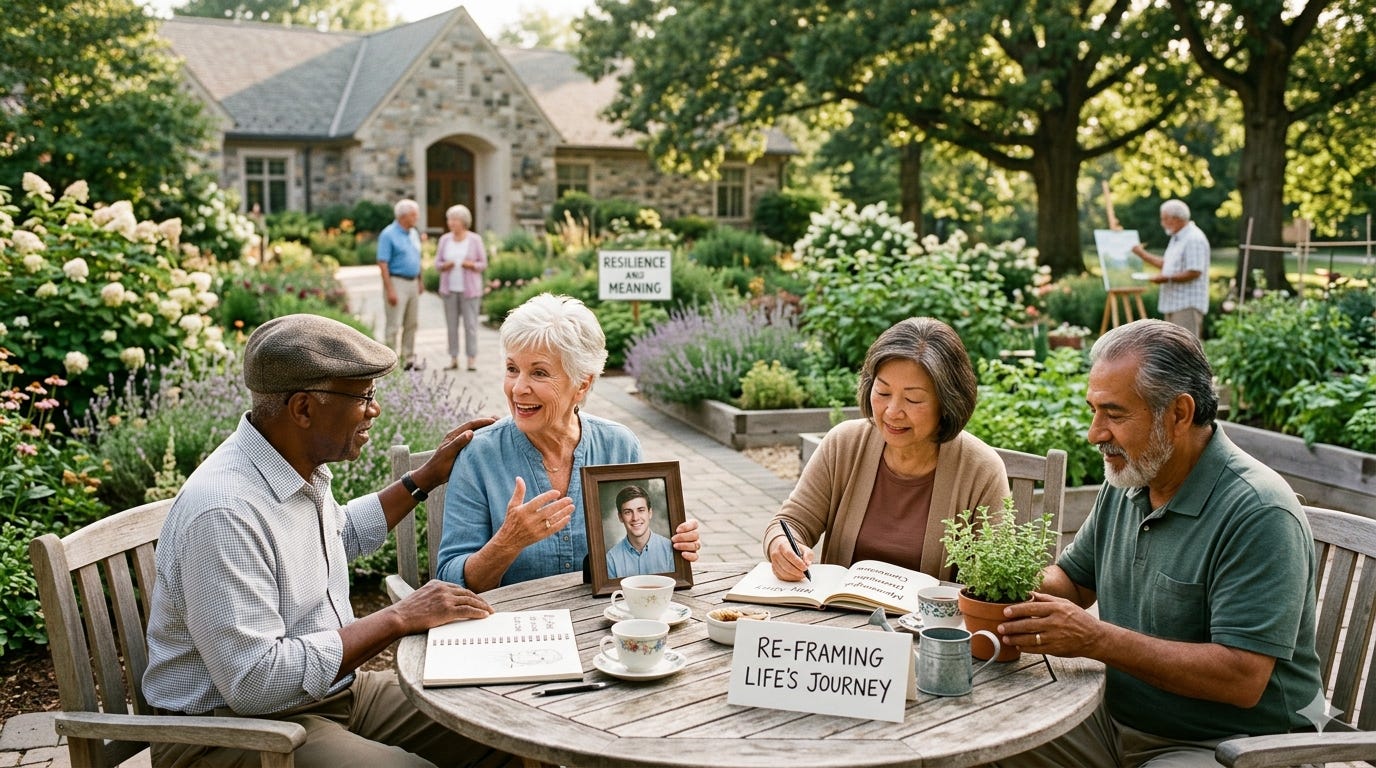
That feeling can be strengthened at any age by building the right resources: relationships, spiritual life, purpose, practical support, community, and — perhaps most importantly — a framework for understanding your own experience. This handout is organized around three dimensions of that framework, with real-life suggestions you can begin today.
1. Comprehensibility: Making Sense of This Stage of Life
Can I understand what I’m experiencing — or does it feel confusing, fragmented, or without a story?
Later life brings a concentration of changes — in the body, in relationships, in roles, in the world. Retirement reshapes identity. Children grow distant or grow closer. Friends and spouses die. The body changes in ways that can feel bewildering. When these changes feel chaotic, anxiety rises. When they can be placed within a framework that makes sense — personal, emotional, spiritual — people feel steadier, more whole, more capable of facing what comes next.
This is not primarily a medical question. It is a meaning question. The deepest work of comprehensibility in later life is not understanding your medications — though that matters too — it is making sense of what you have lived, who you have become, and what this chapter is asking of you.
What you can do
Engage in life review. This is not nostalgia. It is the deliberate work of looking back at what you’ve lived and finding the thread that connects it. What were the turning points? What do you understand now that you couldn’t have understood at 30? Tell your story. Write it down. When life feels like a coherent narrative, you feel more grounded.
Name what you’re grieving. Later life involves real losses — of people, roles, capacities, futures once imagined. Unnamed grief hardens into bitterness or withdrawal. Named grief — spoken, shared, honored — can be integrated into the larger story of a life. Grief is not a sign that something has gone wrong. It is a sign that something mattered.
Reframe this stage as development, not decline. Our culture says aging means things get worse. The research is more hopeful: many people become emotionally steadier with age, life satisfaction often rises after midlife, and the capacity for gratitude and wisdom deepens. Later life is a developmental stage — a time when productivity may narrow but meaning can deepen.
Stay intellectually and spiritually curious. Take a class, join a discussion group, study a sacred text, read something that challenges you. The world feels less overwhelming when you’re engaging with it rather than retreating from it. Learning is not just cognitive exercise — it is a way of saying: I am still here. I am still growing.
Understand your health without being captured by it. Know your conditions, your medications, your care plan. But don’t let the medical narrative become the whole story. You are not your diagnoses. Health literacy matters — but so does the capacity to hold medical reality within a larger story of meaning, identity, and purpose.
2. Manageability: Having What You Need to Cope
When difficulty comes, do I have the resources — inner and outer — to meet it?
Well-being after 65 does not depend on avoiding difficulty. It depends on having the resources to meet it — and those resources are not only medical. They include the relationships that sustain you, the emotional skills you’ve built over a lifetime, the practical foundations that keep daily life manageable, and the spiritual practices that help you bear what cannot be fixed.
What you can do
Tend your closest relationships. Well-being doesn’t require many friends — it requires a few who genuinely care. Schedule regular contact. Express appreciation. Show up. Research consistently shows that the quality of close relationships is one of the strongest predictors of health and longevity after 65.
Draw on emotional skills you already have. Decades of managing difficulty, adapting to change, and showing up for people you love — these are not incidental. They are among your most powerful health resources. Older adults often report greater emotional steadiness than younger people, probably because of accumulated life experience.
Accept help as a strength. For lifelong providers and protectors, receiving help can feel like failure. It isn’t. It is one of the most important emotional capacities of later life. The people who flourish aren’t those who never need support — they’re those who can ask for it and receive it with grace.
Protect the practical foundations. Stable housing, transportation, financial planning, advance directives, hearing and vision care, daily movement, and sleep. These aren’t luxuries — they’re the infrastructure that makes everything else possible. When basics are secure, you have the capacity to invest in what matters most.
Know where to turn when you need support. Your local Area Agency on Aging connects you to meals, in-home help, caregiver support, transportation, and referrals. Knowing where to start is itself a resource — it transforms a vague sense of being overwhelmed into a specific plan.
3. Meaningfulness: Feeling That Life Is Still Worth Investing In
Do I feel that life still asks something of me — that I still matter?
This may be the most important dimension of all. Research consistently finds that among the oldest adults, the sharpest decline in well-being is not anxiety or sadness — it is the loss of the feeling that one’s activities are worthwhile. When meaning drains away, everything else follows. When it remains, people can weather extraordinary difficulty.
The good news: meaning does not depend on productivity. As responsibilities narrow, meaning can deepen — shifting from career to legacy, from achievement to presence, from doing to being. For many people, later life is when the deepest sense of purpose finally becomes available — not despite the losses, but because of the clarity that loss can bring.
What you can do
Stay woven into the life of others. Loneliness is not just a feeling — it is a health condition. The antidote is not simply being around people. It is being meaningfully connected — through friendship, family, community, faith, or shared purpose.
Be a source of blessing. Mentor, volunteer, write family history, bear witness to what matters. The deepest purpose often comes from what you give. Legacy is not only biological — it is moral, spiritual, and relational.
Embrace the shift from resume to eulogy. The question is no longer “What did I achieve?” but “What kind of person have I been, and what kind of person am I still becoming?” This is not a retreat from life. It is a deepening of engagement with what actually matters.
Practice gratitude — not as politeness, but as discipline. Each evening, note three things that went well. Express thanks directly. Gratitude retrains attention from what’s missing toward what sustains you. It is one of the few practices with measurable effects on mood, sleep, and connection.
Cultivate spiritual life. Prayer, meditation, ritual, and contemplation help people hold loss and gratitude at the same time. Research links active spiritual practice with lower anxiety, greater life satisfaction, and deeper connection. The benefit is strongest when spiritual life deepens meaning and hope.
Give your days structure and rhythm. A weekly pattern — a class, a walk with a friend, worship, a call to family — anchors meaning in time. The activities matter less than the rhythm itself.
Reach toward someone who is drifting. Notice who is no longer showing up. A phone call, a visit, a note — these are not small gestures. They are acts of rescue. And they strengthen purpose in both directions.
The Resources That Build Coherence: GRRs and SRRs
The broad reserves and specific tools that strengthen the Sense of Coherence
Antonovsky identified two kinds of resources that strengthen the Sense of Coherence. He called them Generalized Resistance Resources (GRRs) and Specific Resistance Resources (SRRs).
Generalized Resistance Resources are the broad, durable assets that help you cope across many kinds of challenge. They are the deeper reserves you draw on again and again throughout life. In later life, GRRs include things like: emotional maturity, faith or spiritual grounding, a habit of reflection, supportive family and friends, congregational belonging, stable housing, financial security, transportation, access to healthcare, and opportunities for learning and social participation. These are not luxuries. They are the foundations on which well-being rests.
Specific Resistance Resources are more targeted. They are the particular skills, practices, relationships, and knowledge you mobilize for a specific challenge. If you break a hip, the GRR is your supportive family; the SRR is the physical therapist, the grab bars in your bathroom, and the specific exercises you do each morning. If you lose a spouse, the GRR is your lifelong capacity for emotional connection; the SRR is the grief group, the mourning rituals, and the friend who calls every Thursday.
Aging well is not the absence of struggle. It is the presence of resources — relationships, meaning, purpose, community, and the capacity to make sense of one’s own life — that help us meet struggle with coherence and hope.
What helps you feel most alive right now?
And who in your life might need someone to notice them?